






Multi-Robot Systems
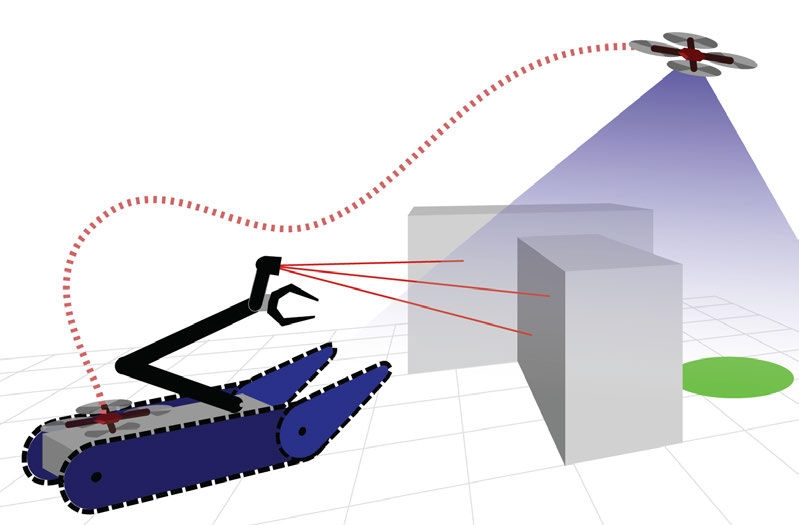
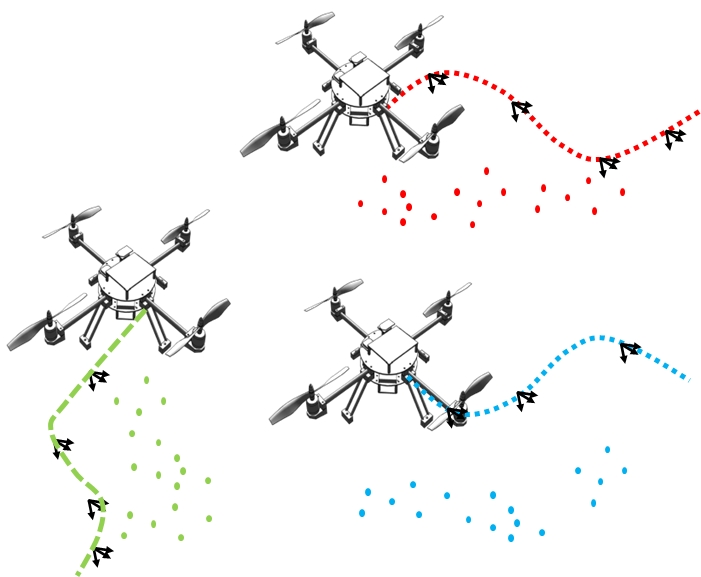
Teams of robots can succeed in situations where a single robot may fail. We investigate multi-robot systems composed of homogeneous or hetereogeneous robots, using both centralized and distributed communication. These teams are applied to problems in search and rescue robotics, as well as mapping and navigation.
Superhuman Safe and Agile Racing through Multi-Agent Reinforcement Learning
Autonomous systems have achieved superhuman performance in isolation or simulation, yet they remain brittle in shared, dynamic real-world spaces. This failure stems from the dominant single-agent paradigm for physical applications, where other actors are ignored or treated as environmental noise, preventing effective coordination. Here we show that multi-agent reinforcement learning provides the essential safety scaffolding required for real-world interaction. Using high-speed quadrotor racing as a high-stakes testbed, we train agents to navigate complex aerodynamic interactions and strategic maneuvering with a variable number of racers. Through league-based self-play, agents evolve sophisticated anticipatory behaviors, including proactive collision avoidance, overtaking, and handling multi-agent physical interactions, including aerodynamic downwash. Our agents outperform a champion-level human pilot in multi-player races at speeds exceeding 22 m/s, while simultaneously reducing collision rates by 50% compared to state-of-the-art single-agent baselines. Crucially, training with diverse artificial agents enables zero-shot generalization to safer human interaction.
References

Superhuman Safe and Agile Racing through Multi-Agent Reinforcement Learning
ArXiv Preprint, 2026.
Decentralized Visual SLAM
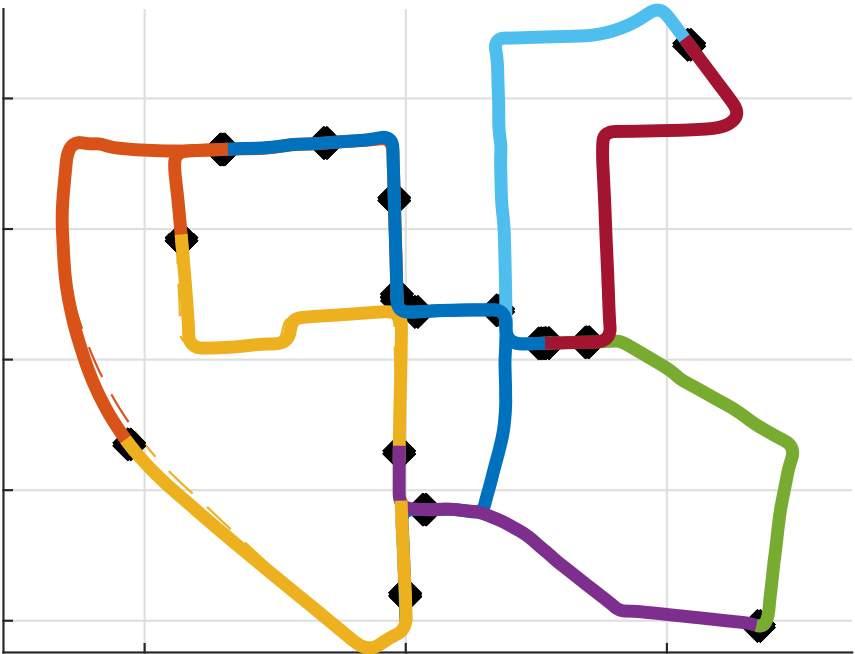
Decentralized visual simultaneous localization and mapping (SLAM) is a powerful tool for multi-robot applications in environments where absolute positioning systems are not available. It allows a group of robots to know how the current pose of each robot relates to all its previous poses, and all current and previous poses of the entire group. Being visual, it relies on cameras, cheap, lightweight and versatile sensors, and being decentralized, it does not rely on communication to a central ground station. In this project, we develop and integrate state-of-the-art decentralized SLAM components.
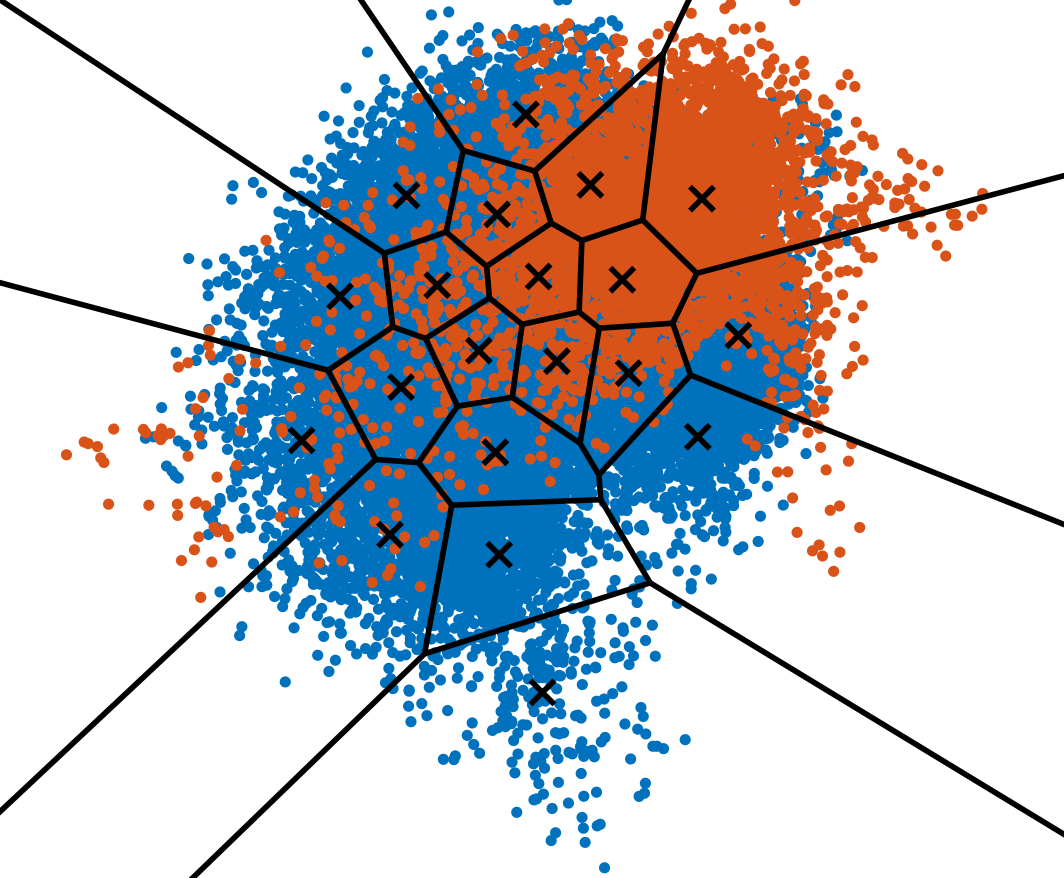
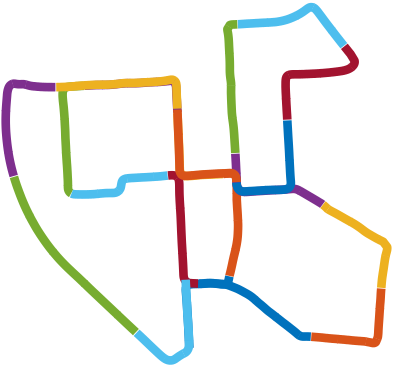
We have started this line of research by investigating data-efficient visual place recognition, which is an essential component of SLAM. Classically, if a robot would want to know whether a place it sees has been previously seen by the other robots, it would need to send data to all other robots, resulting in a data exchange complexity that is linear with the robot count. We have shown that if visual place recognition can be cast to key-value lookup, this complexity can be reduced to being constant in the robot count, using a simple technique also used in Distributed Hash Tables (DHTs): deterministically assigning keys to robots. We have shown how to achieve this reduction both for bag-of-words visual place recognition and for place recognition that uses recent, machine learned full-image descriptors (NetVLAD).
Using this method for place recognition, and decentralized pose graph optimization, we have developed the first-of-its-kind decentralized visual SLAM system, whose code is available online. The main bandwidth bottleneck of that system is the information that is exchanged for relative pose estimation between robots, which is why our latest research on this subject is in Smart Interest Points that are identified using machine learning .
References
Data-Efficient Decentralized Visual SLAM
IEEE International Conference on Robotics and Automation (ICRA), 2018.

Efficient Decentralized Visual Place Recognition From Full-Image Descriptors
IEEE MRS 2017: the 1st International Symposium on Multi-Robot and Multi-Agent Systems
Efficient Decentralized Visual Place Recognition Using a Distributed Inverted Index
IEEE Robotics and Automation Letters (RA-L), 2016.
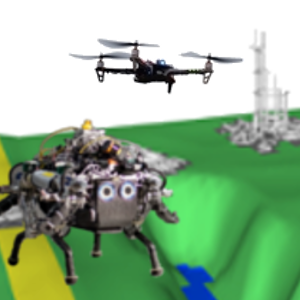
Active Autonomous Aerial Exploration for Ground Robot Path Planning
References
Active Autonomous Aerial Exploration for Ground Robot Path Planning
IEEE Robotics and Automation Letters (RA-L), 2016.
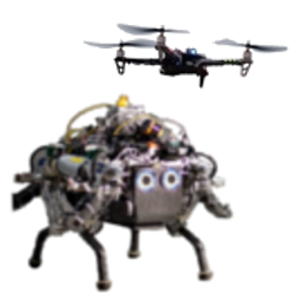
Collaborative Localization of Aerial and Ground Robots through Elevation Maps
International Symposium on Safety, Security, and Rescue Robotics (SSRR), Lausanne, 2016.
Collaborative Monocular SLAM with Multiple MAVs
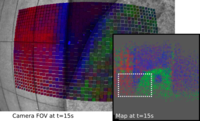
Multiple MAVs run a Visual Odometry algorithm and stream their key-frames to a ground-station. The Collaborative Structure from Motion system on the centralized ground-station combines all received information in real-time and creates a global map of the environment.
We are currently working on a decentralized algorithm in which there is no central ground station, but where the robots collaborate on a shared map using distributed consensus. Efficient Decentralized Visual Place Recognition is our most recent contribution to this endeavour. This place recognition algorithm significantly reduces the bandwidth required for place recognition, compared to previous decentralized approaches.
References
Aerial-guided Navigation of a Ground Robot among Movable Obstacles
References
Aerial-guided Navigation of a Ground Robot among Movable Obstacles
IEEE International Symposium on Safety, Security, and Rescue Robotics (SSRR), Toyako-cho, 2014.